
Real-time notifications
Webhooks allow your application to receive automatic notifications whenever important events happen in Kobana, such as payments received, bank slips registered or transfers confirmed.
How it works
Event occurs
in Kobana (e.g.: bank slip paid)
Kobana sends
HTTP POST request to your URL
Your application
processes the event and responds with 200 OK
Kobana confirms
successful delivery
Receive instant information about important events in your account.
All requests are signed with HMAC-SHA256 to ensure authenticity.
In case of failure, Kobana automatically resends the webhook up to 10 times.
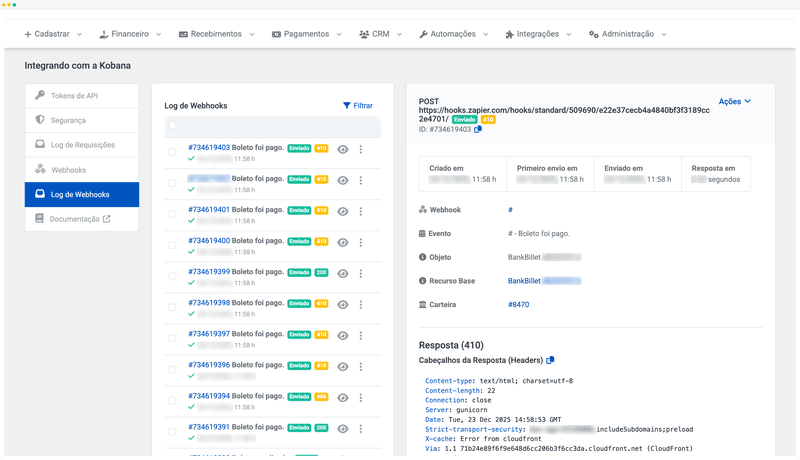
Check the complete history of deliveries and status of each webhook.
Payload Structure
Each webhook sent by Kobana follows a standardized structure, making processing easy in your application.
Content-Type, X-Kobana-Event, X-Kobana-Signature
Event code and timestamp
Type, internal ID and public UUID of the resource
Resource data at the time of the event
{
  "event": {
    "code": "bank_billet.paid",
    "occurred_at": "2025-01-15T10:30:00Z"
  },
  "resource": {
    "type": "BankBillet",
    "id": 123456,
    "uid": "a1b2c3d4-e5f6-7890-abcd-ef1234567890"
  },
  "data": {
    "amount": 150.50,
    "paid_amount": 150.50,
    "paid_at": "2025-01-15T10:30:00Z",
    "customer_person_name": "John Smith",
    "status": "paid"
  }
}curl -X POST https://api.kobana.com.br/api/v2/data/webhooks \
-H "Authorization: Bearer $TOKEN" \
-H "Content-Type: application/json" \
-d '{
"webhook": {
"name": "Payment Notifications",
"url": "https://your-app.com/webhooks/kobana",
"events": ["bank_billet.paid", "pix.paid"],
"content_type": "application/json",
"ssl_verification_enabled": true,
"active": true
}
}'Configuring Webhooks
Configure webhooks via API or through the Kobana dashboard in Settings > Webhooks.
nameDescriptive webhook nameurlDestination URL (HTTPS recommended)eventsList of events that trigger the webhookssl_verification_enabledValidate SSL certificate (default: true)activeWebhook active (default: true)Security and Validation
All webhook requests include an HMAC-SHA256 signature in the X-Kobana-Signature header. Validate this signature before processing the event.
require 'openssl'

def valid_signature?(payload, signature, secret_key)
  expected = 'sha256=' + OpenSSL::HMAC.hexdigest('SHA256', secret_key, payload)
  Rack::Utils.secure_compare(expected, signature)
end

# In controller
post '/webhooks/kobana' do
  payload = request.body.read
  signature = request.env['HTTP_X_KOBANA_SIGNATURE']

  unless valid_signature?(payload, signature, ENV['KOBANA_WEBHOOK_SECRET'])
    halt 401, 'Invalid signature'
  end

  event = JSON.parse(payload)
  ProcessWebhookJob.perform_later(event)
  status 200
endimport hmac
import hashlib
def valid_signature(payload, signature, secret_key):
expected = 'sha256=' + hmac.new(
secret_key.encode(),
payload.encode(),
hashlib.sha256
).hexdigest()
return hmac.compare_digest(expected, signature)
# In Flask
@app.route('/webhooks/kobana', methods=['POST'])
def webhook():
payload = request.data.decode()
signature = request.headers.get('X-Kobana-Signature')
if not valid_signature(payload, signature, os.environ['KOBANA_WEBHOOK_SECRET']):
return 'Invalid signature', 401
event = request.json
process_event(event)
return '', 200const crypto = require('crypto');
function validSignature(payload, signature, secretKey) {
const expected = 'sha256=' + crypto
.createHmac('sha256', secretKey)
.update(payload)
.digest('hex');
return crypto.timingSafeEqual(
Buffer.from(expected),
Buffer.from(signature)
);
}
// In Express
app.post('/webhooks/kobana', (req, res) => {
const payload = JSON.stringify(req.body);
const signature = req.headers['x-kobana-signature'];
if (!validSignature(payload, signature, process.env.KOBANA_WEBHOOK_SECRET)) {
return res.status(401).send('Invalid signature');
}
processEvent(req.body);
res.sendStatus(200);
});<?php
function validSignature($payload, $signature, $secretKey) {
$expected = 'sha256=' . hash_hmac('sha256', $payload, $secretKey);
return hash_equals($expected, $signature);
}
$payload = file_get_contents('php://input');
$signature = $_SERVER['HTTP_X_KOBANA_SIGNATURE'] ?? '';
if (!validSignature($payload, $signature, getenv('KOBANA_WEBHOOK_SECRET'))) {
http_response_code(401);
exit('Invalid signature');
}
$event = json_decode($payload, true);
processEvent($event);
http_response_code(200);Retries and Failures
When your application does not respond successfully (2xx), Kobana automatically resends the webhook with increasing intervals.
Frequently asked questions
Ready to integrate?
Explore our complete documentation and start receiving webhooks today.