
Collecting within the law isn't a checklist — it's an engine
A legal contact window by state, per-person contact limits, typed suppressions, an LGPD lawful-basis record and a legal hold, all evaluated right before every send. Outside the window, it reschedules; suppressed, it doesn't go out.
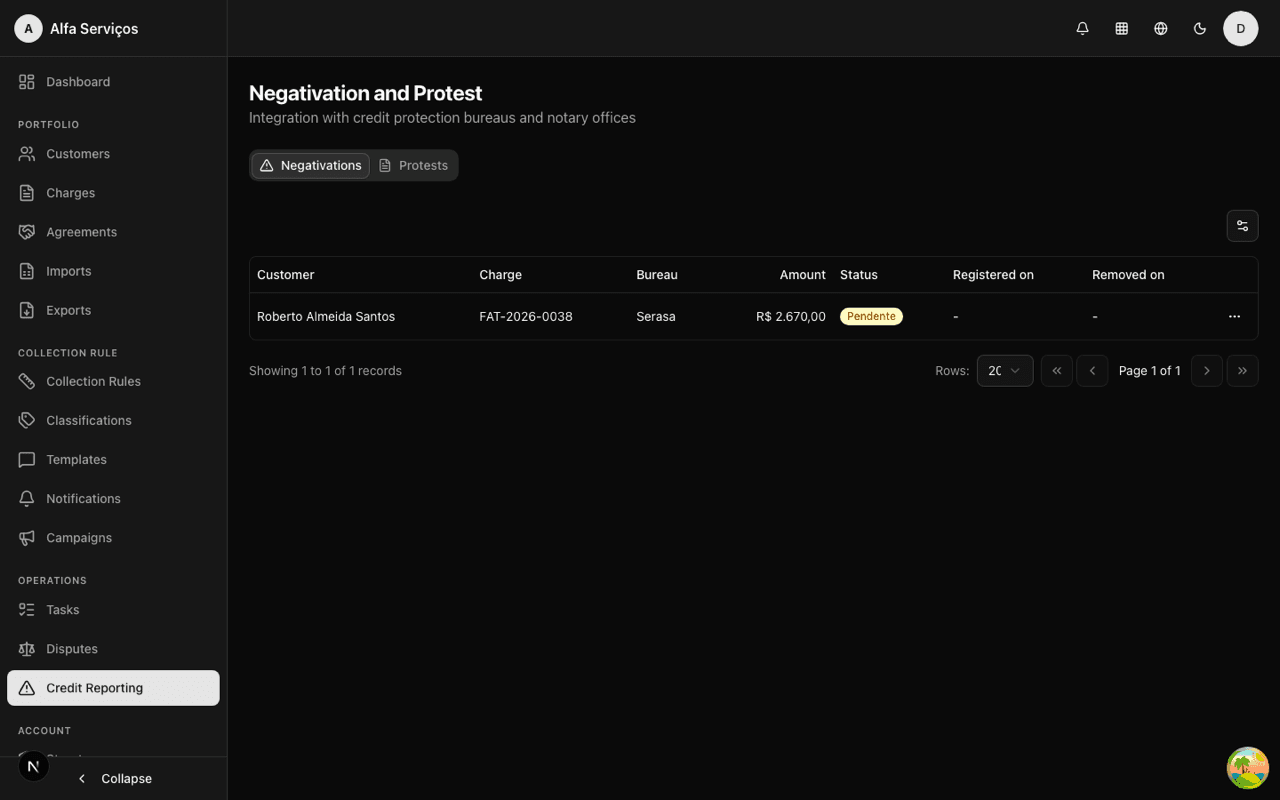
Compliance evaluated before every send, not after
Policies by state
Allowed days and hours by Brazilian state, versioned. Example: São Paulo (Law 15.426/2014) — Monday to Friday 8am–8pm, Saturday 8am–2pm, no Sundays or holidays. A conservative national default applies to the rest.
Per-person limits
Maximum contacts per day and per week, and a minimum interval between contacts, counting every charge and every dunning flow tied to that person.
Suppressions and holds
Opt-out, dispute, legal and 9 other types override any step condition. The legal hold blocks incompatible steps.
Pre-send evaluation
Everything is re-evaluated at send time, with fresh data. If it fails, the message is suppressed or rescheduled — with the reason recorded.
A compliance engine between the dunning flow and the debtor
- Versioned rules with an effective date
- Outside the window = reschedule, never discard
- Conservative default where there's no specific law
- Maximum per day and per week
- Minimum interval between contacts
- Customizable per account
- Scoped to person, debt or channel
- Origin and evidence recorded
- A suppression overrides any step condition
- Evidence and validity period per authorization
- Opt-in recorded when required
- Ready to respond to the ANPD and the data subject
- Full block on credit-bureau reporting and protest
- Reason recorded on every block
- Controlled and audited release
- Human review queue on the dashboard
- Approval recorded in the audit trail
- Controlled cancellation and removal
Real use cases
A message at 9pm? Not in São Paulo
The step came due at 8:30pm on a Tuesday in São Paulo. Instead of discarding it or breaking the law, the system reschedules it for 8am Wednesday.
A customer with 6 open invoices
The limit is 2 contacts per day per person. Even with 6 active charges across different dunning flows, the customer gets at most 2 messages that day.
Time-barred debt
The suppression for a time-barred debt blocks the active charge, and the legal hold prevents credit-bureau reporting — protecting the company from wrongful collection.
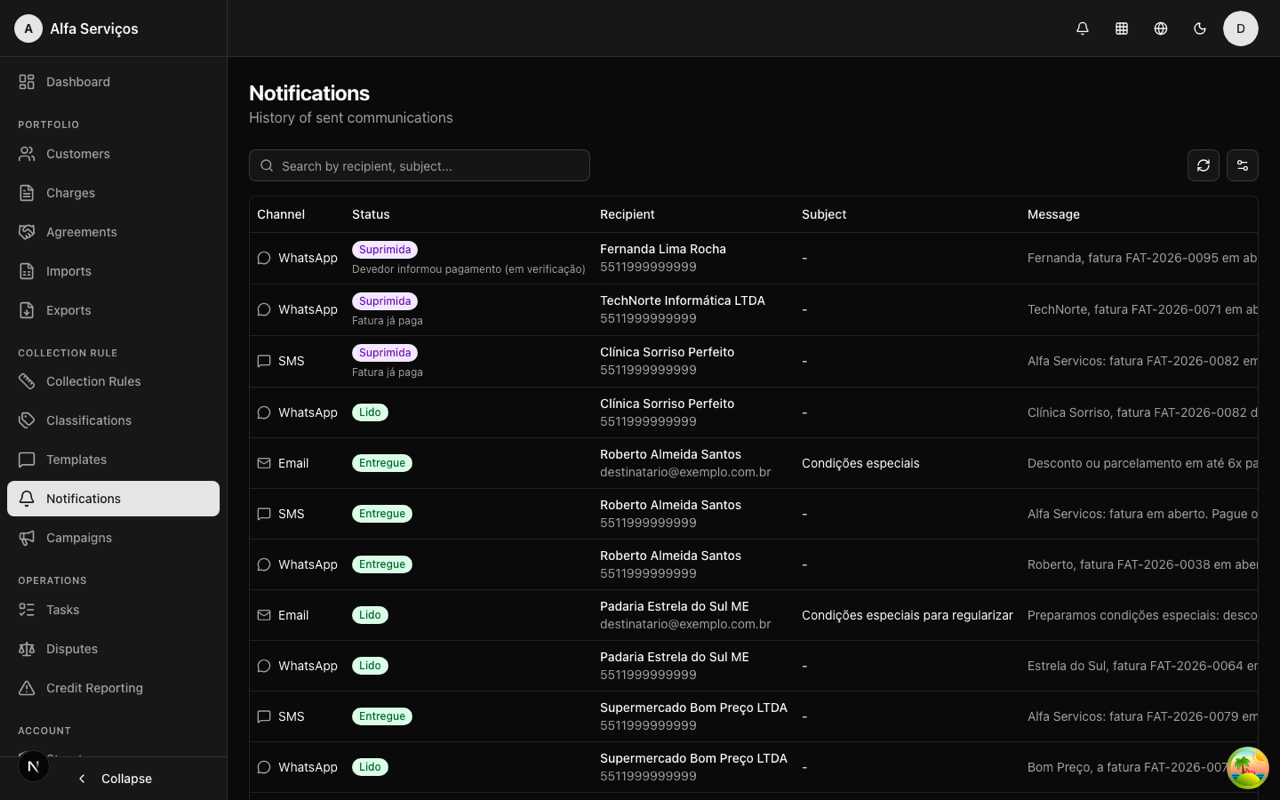
Typed suppressions and legal window: every non-send comes with a reason.
Frequently asked questions
Sleep easy about every message sent
See the compliance engine evaluating the legal window, limits and suppressions before every send.